
Cybersecurity Analyst Resume Examples & Templates
Create a cybersecurity analyst resume that proves you can protect networks, investigate threats, manage security tools, and reduce organizational risk. Explore cybersecurity resume examples for entry-level, experienced, and senior professionals.

The cybersecurity threats that all businesses face have created hundreds of thousands of jobs.
This means having cybersecurity skills and knowing how to communicate them on a resume is a must.
For example, employers don’t just want to see that you know Splunk, Microsoft Sentinel, Python, or vulnerability management. They want proof that you can use those skills to solve their security problems. That’s what your cybersecurity resume needs to demonstrate.
Below, we’ll walk you through the process step-by-step. We’ve also provided customizable templates and winning cybersecurity resume samples to help you get started.
In cybersecurity, the right tools make all the difference. The same is true of your resume; explore our AI resume builder now.
Cybersecurity Analyst Sample Resumes
The following resumes span all career stages, from entry-level candidates to senior cybersecurity analysts.
Entry-level cybersecurity resume
Jordan Carter
Brentwood, TN | (555) 123-4567 | jordan.carter@email.com | linkedin.com/in/jordancarter | github.com/jordancarter
Entry-level Cybersecurity Analyst
Cybersecurity graduate with hands-on experience identifying security weaknesses, monitoring suspicious activity, and investigating potential threats through academic projects, cybersecurity labs, and Capture the Flag competitions. Built and secured Windows and Linux environments, analyzed networks, and conducted vulnerability scans using tools including Splunk, Nessus, Wireshark, and Nmap. CompTIA Security+ certified.
Technical Skills
Network Security | Vulnerability Assessment | Incident Response Fundamentals | Security Information and Event Management (SIEM) | Linux/Windows Administration | Wireshark | Nmap
Nessus Essentials | Splunk | Microsoft Defender | Python | PowerShell | Bash | TCP/IP | DNS | Active Directory | Git | VMware | VirtualBox
Education
Bachelor of Science in Cybersecurity
Middle Tennessee State University | Murfreesboro, TN | 2026
- Relevant Coursework: Network Security, Ethical Hacking, Digital Forensics, Secure Systems Administration, Cryptography, Cloud Security
Certifications
CompTIA Security+
Google Cybersecurity Professional Certificate
CompTIA Network+ (In Progress)
Projects
Home Cybersecurity Lab
- Goal: Build a simulated enterprise environment to practice identifying threats, analyzing suspicious activity, and testing security controls.
- Tools: Vmware, Windows, Linux, Active Directory, Splunk, Nessus
- Configured Active Directory and simulated security incidents in a Windows/Linux environment, using Windows Event Viewer and Splunk to identify and investigate suspicious activity.
- Conducted vulnerability scans with Nessus, analyzed identified weaknesses, and documented remediation recommendations to strengthen the lab’s security posture.
Network Security Assessment, MTSU Department of Technology
- Goal: Assess a simulated network for vulnerabilities, suspicious activity, and security weaknesses, then recommend improvements based on findings.
- Tools: Nmap, Wireshark
- Identified open ports, analyzed packet captures, and recommended security improvements based on findings.
- Created a professional security assessment report summarizing risks and mitigation strategies.
Capture the Flag (CTF) Challenges
- Goal: Apply cybersecurity concepts in simulated attack and defense scenarios while building practical experience across multiple areas of security.
- Areas of focus: Web security, privilege escalation, cryptography, digital forensics
- Completed beginner and intermediate cybersecurity challenges focused on web security, privilege escalation, cryptography, and digital forensics.
- Developed problem-solving skills while practicing real-world attack and defense techniques.
Why this resume works:
- The candidate isn’t trying to hide that he’s early in his career. Instead, he is giving employers evidence of what he can do through his degree, certifications, cybersecurity lab, network assessment, and CTF challenges.
- Including LinkedIn and GitHub links allows recruiters to take a more in-depth look at the candidate’s work.
- The candidate knowledgeably uses industry-specific terminology throughout, much of which may serve as resume keywords.
-
💡 Our expert says

This resume balances plain language with technical terminology. A recruiter doesn’t need a cybersecurity background to understand phrases like “finding security weaknesses” and “monitoring suspicious activity,” while a technical hiring manager can still find terms like Splunk, Nessus, incident response, and vulnerability assessment. That’s an important balance to strike because your resume may be reviewed by a recruiter who isn’t a cybersecurity expert and one who is.
You, too, can create a strong cybersecurity resume even with limited experience.
Cybersecurity analyst resume example
-
💡 Our expert’s advice
Always make sure to activate your links so that recruiters can “click” and be taken to your profile.
Maya Chin
San Diego, CA | (619) 555-0184 | maya.chin@email.com | linkedin.com/in/maychin | github.com/mchin-security
Cybersecurity Analyst
Cybersecurity Analyst with 5 years experience identifying threats, investigating security incidents, and protecting enterprise systems across healthcare and financial environments. Experienced in monitoring security events and responding to cyber threats in health and finance sectors. Experienced in vulnerability management, SIEM administration, incident response, and security compliance across Windows, Linux, and cloud environments. Reduced critical vulnerabilities by 42%, improved incident response time by 35%, and automated security processes to improve team efficiency.
Core Skills
Threat Analysis | Incident Response | Security Information and Event Management (SIEM) | Security Operations Center (SOC) | Risk Assessment Network Security | Endpoint Protection | Cloud Security (AWS/Azure) | Active Directory | Identity and Access Management (IAM) | Firewall Administration | MITRE ATT&CK Framework | NIST Cybersecurity Framework
Professional Experience
Cybersecurity Analyst
Pacific Health Systems | San Diego, CA | 2023 to Present
- Monitor security activity across an enterprise environment supporting 2K+ users, using MS Sentinel and Splunk to investigate alerts, identify suspicious activity, and escalate critical incidents.
- Reduced critical vulnerabilities 42% by conducting monthly vulnerability assessments, risk prioritization, and remediation planning.
- Led investigations and response efforts for malware infections, phishing attacks, and unauthorized access attempts, reducing average response time by 35%.
- Implemented endpoint detection and response policies using CrowdStrike Falcon, improving threat visibility across corporate devices.
- Collaborated with IT infrastructure teams to strengthen firewall rules, access controls, and patch management processes.
- Develop security documentation, playbooks, and incident reports to support compliance and continuous improvement.
Information Security Analyst
West Coast Financial Group | Irvine, CA | 2021 to 2023
- Analyzed security logs using Splunk and Microsoft Defender to identify suspicious activity across cloud and on-premises systems.
- Conducted quarterly vulnerability scans with Nessus and partnered with system administrators to prioritize and resolve identified security weaknesses.
- Assisted in achieving successful annual security audits by documenting security controls aligned with NIST and PCI DSS requirements.
- Created PowerShell scripts that automated routine security reporting, reducing manual reporting time by 50%.
- Developed and delivered cybersecurity awareness training that contributed to a 28% reduction in employee phishing simulation failures.
Education
Bachelor of Science in Cybersecurity
California State University | San Bernardino | 2021
Certifications
CompTIA Security+
CompTIA CySA+
Certified Ethical Hacker (CEH)
Microsoft Certified: Security Operations Analyst Associate (SC-200)
Technical Tools and Platforms
Security Tools: Splunk | Microsoft Sentinel | CrowdStrike Falcon | Nessus | Qualys, Wireshark |Nmap | Microsoft Defender | Burp Suite
Operating Systems: Windows Server |Windows 11 | Ubuntu | Kali Linux |Red Hat |Enterprise Linux
Cloud Platforms: Microsoft Azure | AWS
Programming and Scripting: Python | PowerShell | Bash | SQL
Why this resume works:
- Skills listed in the Core Skills section are demonstrated in action in the work experience bullet points
- Technology can change a lot in 5 to 6 years, but the candidate shows their education is still up to date through certifications.
- The candidate lists specific tools, systems, platforms, and programming languages at the end of the resume so they can be easily located (as opposed to those simply scattered through the work experience).
-
💡 Our expert’s advice
Once you’ve gained real-world experience, your results should carry more weight than your education. After several years, employers want to know what changed because you were there.
Instead of only describing what you were responsible for, try to show evidence of problems solved, risk reduced, time saved, incidents handled, and systems protected. This is why Maya’s resume is a great example.
Senior cybersecurity analyst resume template
Markendre Brown
Detroit, MI | (408) 555-0176 | markendre.brown@email.com | linkedin.com/in/markendrebrown | github.com/mbrown-security
Senior Cybersecurity Analyst
Senior Cybersecurity Specialist with 8+ years experience leading security operations, responding to high-risk incidents, and protecting large enterprise environments. Leads six-person team supporting 8K+ users, with experience improving threat detection, automating security response, and reducing critical vulnerabilities across cloud and on-premises systems.
Leadership and Cybersecurity Expertise
Security Operations Center (SOC) Leadership | Threat Intelligence | Incident Response | Digital Forensics | Patch Management | Security Information and Event Management (SIEM) | Endpoint Detection and Response (EDR) | Cloud Security | Identity and Access Management (IAM) | Security Architecture | Risk Assessment and Compliance | Malware Analysis | MITRE ATT&CK Framework | NIST Cybersecurity Framework | Zero Trust Security
Professional Experience
Senior Cybersecurity Analyst
Innovatech Systems | Detroit, MI| 2022 to Present
- Lead a team of six cybersecurity analysts responsible for monitoring and protecting a hybrid enterprise environment supporting 8K+ users, overseeing investigations, incident response, and escalation.
- Direct incident response for high-severity security events, reducing mean time to detect (MTTD) by 38% and mean time to respond (MTTR) by 44%.
- Designed and implemented advanced SIEM detection rules in Microsoft Sentinel and Splunk, increasing high-confidence threat detection while reducing false positives by 32%.
- Develop automated response workflows using Microsoft Defender and PowerShell, eliminating repetitive manual tasks and saving more than 400 analyst hours annually.
- Coordinate enterprise-wide vulnerability management initiatives that reduced critical vulnerabilities by 57% within 12 months.
- Lead Purple Team exercises with infrastructure and application teams to validate security controls, identify defensive gaps, and strengthen the organization’s ability to detect and respond to attacks.
Cybersecurity Analyst
Kalamazoo Financial Services | Kalamazoo, MI | 2019 to 2022
- Monitored and investigated security events across cloud and on-premises environments using Splunk, Microsoft Sentinel, and CrowdStrike Falcon.
- Investigated phishing campaigns, ransomware activity, insider threats, and unauthorized access attempts while maintaining strict incident documentation.
- Conducted threat hunting activities using MITRE ATT&CK techniques to proactively identify indicators of compromise.
- Managed quarterly vulnerability assessments with Nessus and Qualys, collaborating with infrastructure teams to prioritize remediation.
- Launched phishing awareness initiatives that reduced successful phishing simulation clicks by 46%.
Information Security Analyst
Great Lakes Data Solutions | Traverse City, MI | 2017 to 2019
- Supported 24/7 SOC operations by monitoring security alerts, investigating suspicious network activity, and escalating potential incidents
- Reviewed firewall configurations, user access audits, and endpoint security monitoring.
- Supported PCI DSS and ISO 27001 compliance initiatives by documenting security controls and participating in internal audits.
- Partnered with network engineers to strengthen perimeter defenses and improve segmentation strategies.
Education
Bachelor of Science in Computer Science
University of Michigan | Ann Arbor, MI
Certifications
Certified Information Systems Security Professional (CISSP)
GIAC Certified Incident Handler (GCIH)
CompTIA CySA+
CompTIA Security+
Microsoft Certified: Security Operations Analyst Associate (SC-200)
Microsoft Certified: Azure Security Engineer Associate (AZ-500)
Technical Skills
Security Platforms: Microsoft Sentinel, Splunk Enterprise Security, CrowdStrike Falcon, Microsoft Defender XDR, Qualys VMDR, Nessus, Palo Alto Cortex XDR
Cloud and Infrastructure: AWS, Microsoft Azure, VMware, Active Directory, Entra ID (Azure AD), Okta
Networking: TCP/IP, DNS, VPN, Firewalls, IDS/IPS, Zero Trust Architecture
Programming and Automation: Python, PowerShell, Bash, SQL, REST APIs
Frameworks and Standards: NIST CSF, MITRE ATT&CK, CIS Controls, ISO 27001, PCI DSS
Why this resume works:
- Career progression demonstrates increasing responsibility and leadership.
- Certifications show that knowledge is current and up to date; the graduation date is not included.
- Technical skills are reiterated at the end of the resume to make specific platforms, programs, and frameworks easy to locate.
This candidate’s resume shows his progression from supporting security operations to independently investigating threats and leading analysts and enterprise-wide security initiatives. His certifications also reinforce his continued technical development.
-
💡 Our expert’s advice
Senior resumes need to show more than ability and shouldn’t look like a mid-career analyst with years of experience. The resume should showcase scope, ownership, leadership, decision-making skills, and most importantly, organizational impact.
Once you have your resume ready, you can find roles that fit your security background with ResumeCoach’s Job Match tool.
How To Write a Cybersecurity Resume With ResumeCoach
The strongest cybersecurity resumes are technical and establish credibility. They should also be adapted to the job description and ready to run the gauntlet of Applicant Tracking Systems (ATS).
-
💡 Our expert’s advice
Remember, the first person reviewing your resume may not work in cybersecurity. Don’t assume they understand every tool, acronym, or technical process. Whenever possible, connect your technical expertise to plain-language outcomes (i.e., what you protected, what you found, and what you improved).
In this section, we’ll show you how to write a winning resume that lands you an interview.
1. Choose the right format for your cybersecurity resume
Cybersecurity candidates should select a clean, ATS-friendly resume layout. A reverse-chronological format works well for experienced candidates, as it shows career progression, starting with the most recent and working backwards.
A combination format can aid less-experienced candidates in balancing technical skills and work history. These skills can be derived from certifications, bootcamps, online courses, and even personal projects.
Whichever format you choose, your goal is to make it easy for someone scanning the page to answer these questions:
- What level of cybersecurity professional are you?
- What security problems can you solve?
- What evidence do you have?
2. Write a strong cybersecurity resume summary
A brief summary quickly shows your:
- Experience level
- Technical strengths
- Certifications
Think of your summary as a snapshot of your cybersecurity value proposition. It shows what you bring to the table. If a recruiter only reads part of your resume, the summary is usually it.
For entry-level candidates with little experience, a resume objective can also be a good choice. This similarly short introduction highlights motivations and goals.
Consider the following summary example for an experienced cybersecurity analyst:
Results-driven Cybersecurity Analyst with extensive experience monitoring security events, investigating threats, and securing cloud and on-premises environments. Skilled in Splunk, Microsoft Sentinel, CrowdStrike, and NIST security frameworks.
3. Add cybersecurity resume skills and keywords
Cybersecurity resumes need to balance technical skills, tools, soft skills, and keywords from the job description.
Your keywords should appear naturally in your:
- Resume summary
- Skills section
- Work experience descriptions
The best cybersecurity resume keywords come from the job description itself. Read the post carefully and look for skills, technologies, frameworks, and required certifications. The list below can help you get started:
- Threat Detection
- Incident Response
- Vulnerability Management
- SIEM
- Threat Hunting
- Malware Analysis
- Network Security
- Cloud Security
- Risk Assessment
- IDS/IPS
- Splunk
- Microsoft Sentinel
- CrowdStrike Falcon
- Nessus
- Wireshark
- Active Directory
- Python
- PowerShell
- NIST Cybersecurity Framework
- MITRE ATT&CK Framework
4. Describe your cybersecurity experience with measurable results
Your experience section should focus on achievements, not just duties. Open descriptions with strong action verbs, and include numerical metrics whenever possible. These may include:
- Number or percent of vulnerabilities reduced
- Improved response times
- Number of endpoints monitored
- Number of alerts investigated
- Number of security reports created
- Users, devices, and systems protected
- Hours saved through automation
- Reduction in phishing failures
Look at the following example to see how your results can be highlighted:
Cybersecurity Analyst
ABC Financial Services | San Diego, CA | 2022 to Present
- Monitored security events across a 2,500-user enterprise using Microsoft Sentinel and Splunk, reducing mean time to detect security incidents by 35%.
- Conducted monthly vulnerability assessments with Nessus and partnered with IT teams to remediate 95% of critical vulnerabilities within established SLAs.
- Investigated phishing campaigns, malware infections, and unauthorized access attempts, successfully containing 120+ security incidents while minimizing business disruption.
- Automated security reporting and log analysis using PowerShell, reducing manual reporting time by 12 hours per month and improving SOC efficiency.
- Developed phishing awareness training and incident response playbooks, contributing to a 30% decrease in successful phishing attacks over one year.
5. Include your education and cybersecurity certifications
Both formal education and certifications are important in cybersecurity because they show verified, up-to-date technical knowledge.
The education section is generally located after the experience section, and then followed by a certifications section. You can also choose to include your certifications directly in your education section.
Make sure to include the:
- Name of your degree
- Institution where you were trained
- Year you graduated
-
💡 Our expert’s advice
Where education and certifications belong depends on your level of experience. If you are a recent graduate with limited professional experience, this section will be your strongest selling point and go towards the top. If you’re experienced, your work history and accomplishments will take center stage with your education following.
Think about what could sell your skills to employers. Mention specific coursework that could show them you have these skills.
Most certifications can simply be listed by name. If not readily recognizable, include the awarding institution or a short description.
Consider the following example of a certifications section.
- CompTIA Security+
- CompTIA CySA+ (Cybersecurity Analyst)
- Certified Ethical Hacker (CEH)
- Microsoft Certified: Security Operations Analyst Associate (SC-200)
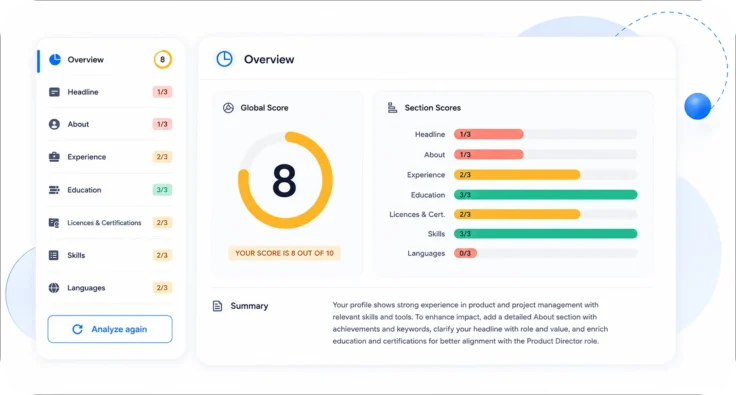
Make sure you include all your certifications on LinkedIn too. You can use our LinkedIn Anlayzer to get an instant score showing you how to improve your profile.
6. Add technical projects, labs, or security tools
Projects and labs can be especially useful for entry-level candidates or those making a pivot to cybersecurity mid-career.
Homelabs and training platforms like Hack the Box, TryHackMe, and Capture the Flag (CTF) competitions demonstrate advanced problem-solving and hands-on experience in real-world environments.
Take a look at the following project section for a cybersecurity analyst resume example to get an idea of how yours could look.
Projects
Enterprise Threat Detection Lab
Tools: Splunk, Microsoft Sentinel, Wireshark, Nessus, VMware
- Built a virtual enterprise network to simulate phishing attacks, malware infections, and unauthorized access attempts.
- Configured SIEM dashboards and alerts to detect suspicious activity and investigate security events.
- Performed vulnerability scans with Nessus and documented remediation recommendations to improve the lab’s security posture.
7. Review your resume for ATS, accuracy, and clarity
The final draft of your resume should be easy to scan and free from errors. Proofread your document and double-check:
- Spelling
- Dates
- Tool and certification names
- Formatting
- Technical terms
You can help guarantee that your resume gets past ATS by using clear headings and plenty of white space.
Remember, your resume should not exaggerate your clearance, certifications, or tool expertise. Accuracy is especially important in technical and security-related roles.
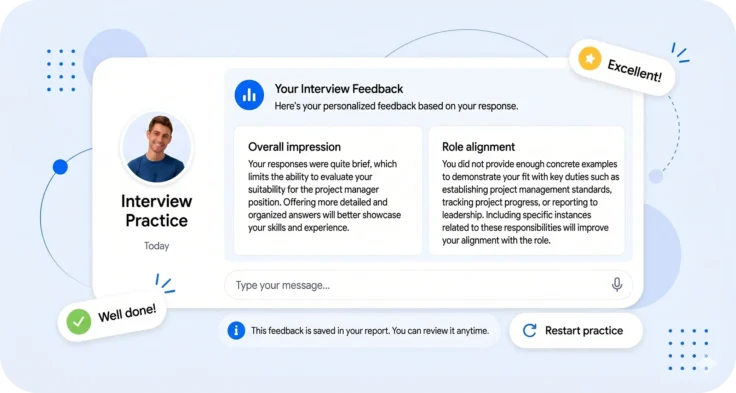
Once you start applying for jobs, consider using our Interview Practice tool to simulate interviews as many times as you want.
FAQs
Generally, your cybersecurity resume should be one page in length, especially if you are an entry-level candidate. One page is usually enough to communicate relevant education, projects, certifications, technical skills, and experience.
The exception would be if you have a lot of experience as a senior analyst. Then, you could extend the resume to two pages.
Yes, including a link to GitHub or another online portfolio, such as a personal website, is a great way to show off relevant:
- Projects
- Scripts
- Labs
- Reports
- Security documentation
It goes without saying that you should never link to an empty or unrelated portfolio.
Feel free to mention an active, relevant security clearance if it is appropriate for the role and allowed by your employer or government contract. Never include confidential details in your resume.
Your cybersecurity resume should be technical enough to show real ability, but still clear and understandable to a recruiter who may not have a background in cybersecurity.
Mention tools, methods, and systems you’re experienced with, as these often serve as resume keywords. Avoid long, jargon-heavy lists or phrases that don’t demonstrate results.
Connect technical terminology to plain-language actions and outcomes whenever possible. Your audience (recruiter) should be able to understand the tools you use and what you accomplished with them.
Yes, you can include labs and projects to demonstrate ability, especially if you have little or no on-the-job experience.
The resume of a Security Operations Center (SOC) Analyst should focus on:
- Monitoring
- Alerts
- Security Information and Event Management (SIEM) tools
- Incident escalation
- Threat detection
They must demonstrate the skills needed to work on the front lines of cybersecurity and stop threats before they harm businesses.
Cybersecurity analysts, on the other hand, can be broader in their experience and skill set. You can include things like risk analysis, vulnerability management, compliance, security policies, and incident response.
Related Professions