


If you’ve scratched your head and wondered about the difference between a CV and a resume, you’re not alone. CV stands for Curriculum Vitae, Latin for “the course of one’s life.” But the specifics of this document—its content and format—vary from place to place.
Simply put, a CV is a more detailed record of your academic and professional career, while a resume is more concise. Understanding when to use these documents can make a difference.
Below, we’ll look at the key elements of each, when to use them, and clear examples to help you choose the right one.
Resume vs. CV: Key Differences
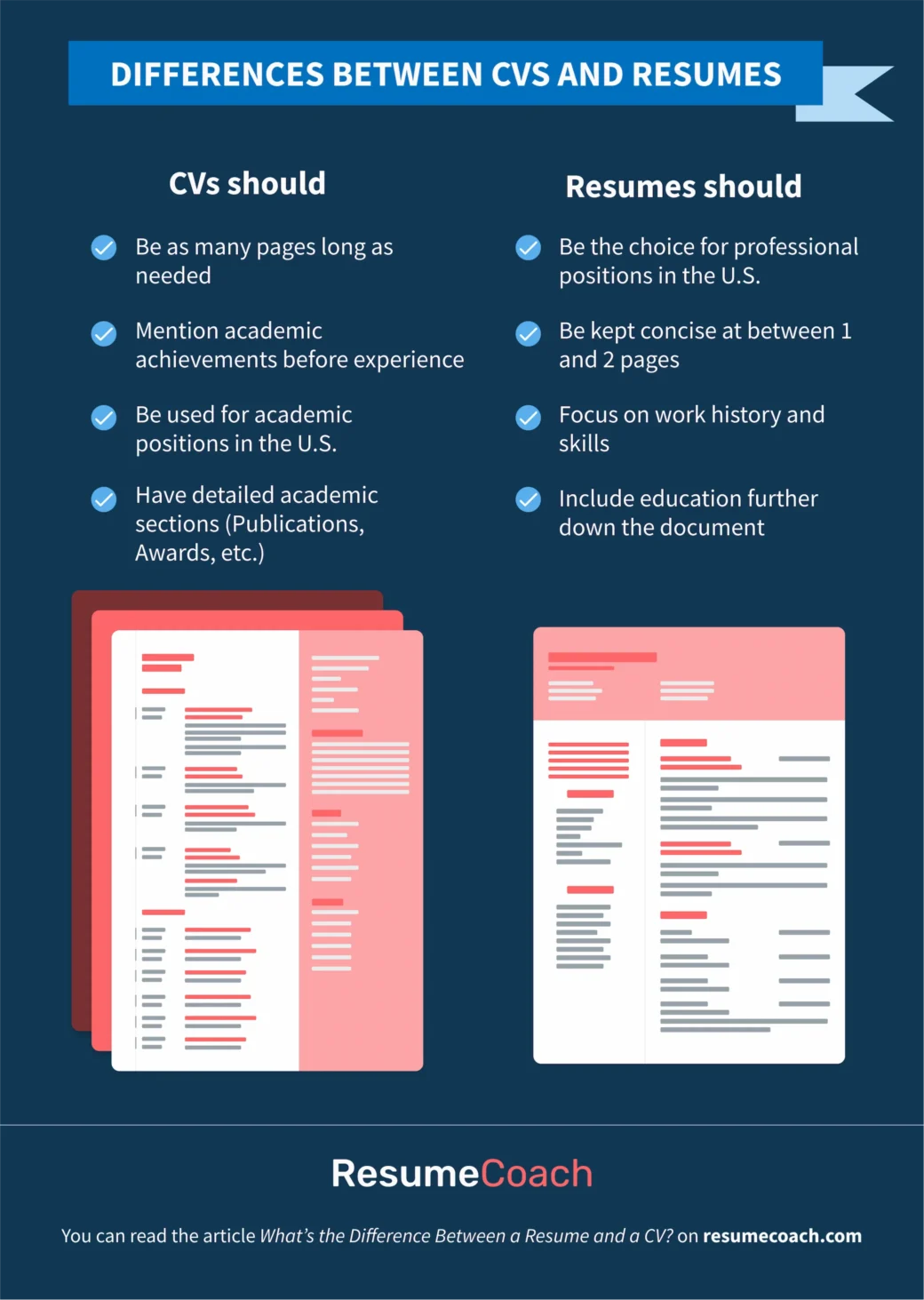
Resumes and CVs share the goal of presenting your qualifications in a user-friendly way. Especially in the United States, however, they differ in how they are used, their structure, and their length.
| Aspect | Resume | CV |
|---|---|---|
| Length | 1-2 pages, concise and tailored | Multiple pages with a comprehensive academic and professional history |
| Content | Skills, experience, and achievements relevant to a specific opening | Full academic and professional background, including publications, research, presentations, and projects |
| Purpose | Job applications in most U.S. industries, including corporate, non-profit, and private-sector | Academic, research, medical, and some international roles |
| Structure | Flexible and customized for each role | Chronological, detailed, consistently structured |
| Geographic Use | Standard in the U.S. for most non-academic job applications | In the U.S., mainly used for academic and research roles; internationally (UK, Europe), often used as the standard term for a resume |
What Is a Resume? The Standard Document for Job Applications
In the U.S. job market, resumes are the documents hiring managers expect to receive. Resumes accompany the job application to give support and context. When their keywords match those of the role, the candidate is considered.
When you write your resume, try to include:
- Strong action verbs
- Quantifiable achievements like metrics or percentages
- Keywords from the job description
- Clear headings for easy scanning
-
💡 Our expert’s advice

Today, many job seekers use artificial intelligence (AI) to create their resumes. ResumeCoach incorporates built-in AI that provides personalized suggestions based on the job description, making it easier to tailor your resume and complete it faster.
Not sure where to start? Try our AI-powered resume builder, and have a brand new resume ready in just a few minutes.
Essential sections for a resume
In your resume, you’re telling your hiring manager who you are and why you’re a good fit for the job. Every piece of information should be directly related to the position you’re applying for.
Here are the main sections that your resume should have:
- Contact information: Name, location, phone number, email address, and LinkedIn
- Professional summary: A brief overview of your strongest points
- Professional experience: Relevant jobs, starting with the most recent and working back
- Education: Diplomas, degrees, certifications, and training
- Skills: A list of skills you have that best match the job
- Languages: Languages you’re able to speak, read, or write in
- Certifications and licenses: Required or voluntary proofs that you are work-ready
For more details and step-by-step instructions, check out our complete resume writing guide.
💡 Our expert’s advice
Customizing your resume or CV for each job application is crucial. Tailoring your resume or cover letter to match the job description can help you get past the Applicant Tracking System (ATS) and catch the attention of hiring managers.
Bear in mind that approximately 75 percent of employers1 and 98.8 percent of Fortune 500 companies use ATS to streamline their hiring process.
You can quickly and easily create a professional resume using an AI resume builder with ATS-friendly templates. You’ll find plenty to choose from in ResumeCoach’s template library.
What Is a CV? The Ideal Format for Research & Academia
You might compare a resume to a movie trailer and a CV to the whole film. Where the resume was brief, the CV is highly detailed. It contains your whole history without leaving anything out, with a special focus on your educational background.
In the United States, CVs are generally limited to use for academic roles, research positions, grants, university jobs, scientific fields, or medical careers. You’ll notice that these fields have one thing in common: extensive educational requirements.
Outside the U.S., CVs are often the go-to document for job applications.
Key information to include in a CV
CVs share many sections with resumes, and you can use your resume as a resource when writing your CV.
However, CVs dig deeper, including additional details like grants and scholarships you’ve been awarded or lists of published works that showcase your expertise. It should include the following:
- Contact information: Your name, professional address (i.e., your office), phone number, email address, and LinkedIn profile
- Education: Degrees you’ve received listed in reverse-chronological order, with details like dissertation and thesis titles
- Publications: Books, articles, chapters, reviews, and peer-reviewed articles, using the citation style (such as MLA, APA, or ASA) expected in your field.
- Awards and honors: Scholarships, grants, fellowships, academic prizes, etc.
Bonus sections to make your CV stand out
Depending on the job and your background, you may include other sections such as:
- List any languages you speak and your proficiency level.
- Detail any conferences, seminars, training, or workshops you have attended and/or presented your research at.
- Provide details on courses that you have taught or assisted with, including the institution and dates.
- Include significant projects you have worked on, especially those relevant to the job.
- If applicable, include an abstract of your dissertation.
- Add a statement that outlines your research interests and plans.
By including these sections, you can create a comprehensive and compelling CV that effectively showcases your qualifications and experiences.
Resume vs. CV: When To Use Which?
Yale University’s Office of Career Strategy notes that in the United States, most employers will expect to see a resume. However, if you are applying for an academic faculty or postdoctoral researcher/fellow position, you might be asked for a CV instead.
Generally, if you’re unsure which to use, use a resume, as CVs are limited to academic and research environments.
| When to use a resume | When to use a CV |
|---|---|
| Corporate job applications | Academic positions |
| Private sector jobs | University teaching roles |
| Internships in companies | PhD applications |
| Entry-level roles | Research fellowships |
| Government jobs | Grant applications |
| Non-profit positions | Medical or scientific careers |
| Industry career changes | Academic conferences or publications |
CVs are more commonly used with job applications outside the U.S. In the UK and many other countries, a CV is the standard document submitted to employers.
American resumes—meaning “summary” in French—and foreign CVs are nearly interchangeable. A little research can help you properly format your resume when applying for jobs in Europe and abroad.
Examples of CV and Resume
Take a look at the following examples to further clarify the differences between CVs and resumes. You can find more examples tailored to specific positions on our resume samples page.
Resume example
Daniel Carter
Chicago, IL | (312) 555-7821 | daniel.carter@email.com
Summary
Software engineer with 4+ years of experience building scalable web applications. Skilled in JavaScript, Python, and cloud-based systems. Proven track record of improving performance and user experience.
Experience
Software Engineer
Lakeview Digital, Chicago, IL | 2022 to Present
- Developed full-stack applications serving 50,000+ users
- Improved page load speed by 30%, increasing user engagement
- Collaborated with cross-functional teams to deliver features on schedule
- Optimized APIs, reducing server response time by 20%
Junior Developer
CodeBridge Solutions, Chicago, IL | 2020 to 2022
- Built frontend components using React and JavaScript
- Assisted in debugging and improving legacy systems
- Contributed to team code reviews and agile workflows
Skills
JavaScript | Python | React | Node.js | AWS | REST APIs
Education
B.S. Computer Science
University of Illinois, 2020
CV example
Emily Johnson, RN
Boston, MA
emily.johnson@email.com | (617) 555-4321
Research Interests
Patient-centered care | Wound management | Nursing education
Education
Boston University
B.S. in Nursing, 2018
Professional Experience
Registered Nurse
Massachusetts General Hospital | 2020 to Present
- Delivered care to 25+ patients per shift in medical-surgical unit
- Led patient education initiatives, improving compliance by 15%
- Assisted in protocol development for wound care and infection prevention
- Mentored 10+ new nursing staff and student nurses
Staff Nurse
Boston Community Hospital | 2018 to 2020
- Collaborated with interdisciplinary teams to improve patient outcomes
- Administered medications and monitored patient vitals
Publications
Johnson, E. (2023). “Innovative Patient Education Methods in Hospital Settings.” Journal of Nursing Practice
Presentations
“Advancing Patient Education in Acute Care,” Northeast Nursing Conference, 2023
Certifications
RN License, Massachusetts, BLS, ACLS
Professional Affiliations
American Nurses Association (ANA)
Technical Skills
Patient Assessment | EMR | IV Therapy | Care Planning
Samples like the ones above can serve as useful templates for writing your own resume or CV. Our AI-powered resume editor can save you valuable time while delivering a true professional result.
And if you already have a resume, you can use our Resume Checker to review it and get the best suggestions for improvement.
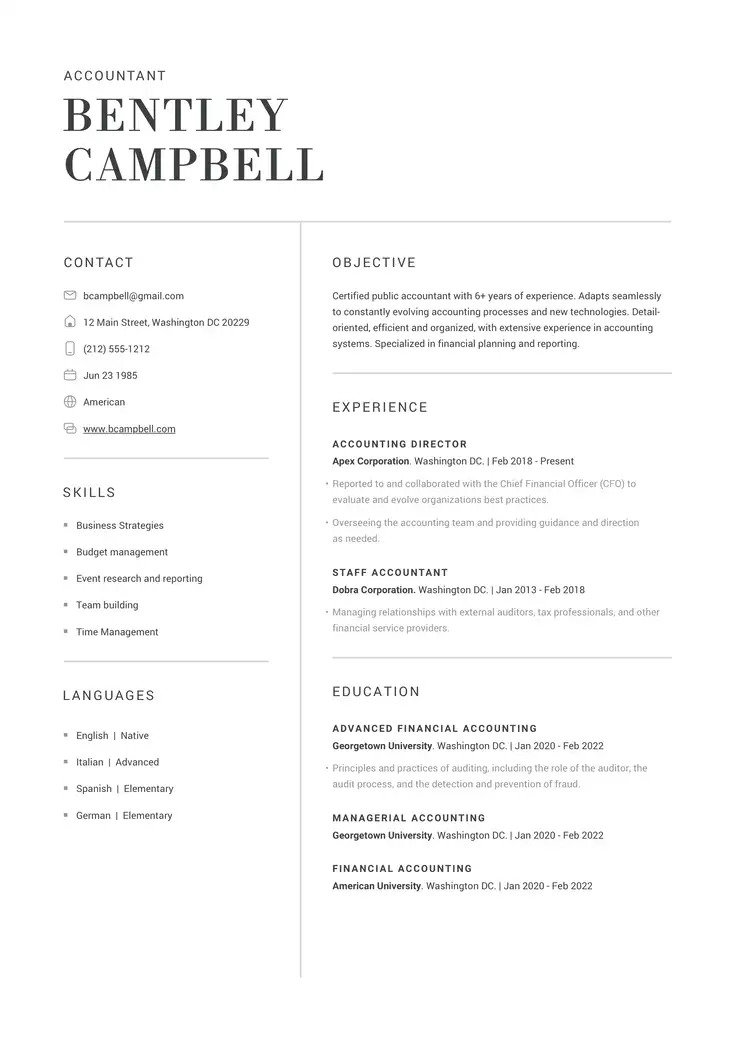
Struggling with Resume Writing?
Ease the process with our templates
FAQs
No. Pull out your resume for most job applications, especially if you’re hunting in the corporate jungle, non-profits, or the public sector stateside. It’s your best bet when you need to be brief yet brilliant about your experience for a specific role.
But, if you’re aiming for academia, research, or top-tier executive positions, or if you’re stepping into the job market beyond the U.S., a CV is your golden ticket. It’s also your ally for academic grants and fellowships.
If you’re applying for a part-time or after-school job, or your first job after graduation, you will use a brief and concise resume.
But your academic career may lead you to situations where a longer CV is needed, for example, when you apply for grants or scholarships, research opportunities, or postdoc positions.
In this case, you’ll write a longer and more detailed CV that focuses on your educational background and projects.
In the United States, most employers expect a standard resume. CVs are reserved for specialized circumstances in academic, medical, or scientific fields.
Outside the U.S., a basic resume is commonly referred to as a CV. For example, consider the Europass CV. These CVs are the standard job application document.
Whichever document is expected or requested is always the best one to use. In the United States, you should generally stick with a resume unless a CV is asked for. This will only happen in specialized fields like science or medicine, or at a research university.
Start with your resume as the foundation for your CV. It probably already includes your work experience and education in reverse-chronological order.
Then, build it out with more detailed academic and professional information, such as publications, research, presentations, certifications, and your thesis or dissertation title.
In the U.S., a resume is generally not called a CV because the two documents are different. The confusion usually comes from other countries, where “CV” is the standard term for what Americans call a resume.
No, your resume should be tailored for each job application. Highlight what makes you perfect for that particular role.
As for your CV, while it’s a broader canvas, you still want to paint the parts of your academic and professional life that resonate most with the position or grant you’re after. Tailoring your approach is key – it’s what could swing doors wide open for you.
Related Blogs
- https://www.jobscan.co/blog/fortune-500-use-applicant-tracking-systems/ ↩︎