
How To Write a Software Engineer Resume: Tips and Examples for 2026
Learn how to engineer your resume as naturally as you’d write computer software, with tips and templates to serve as the hardware.

Our customers have been hired by:





As a software engineer, you’re accustomed to using computer programs to write code, check for bugs, and optimize your work. But you may still feel intimidated when you open a word processor to begin your resume.
Don’t worry, because the following templates and examples will act like a front-end framework for building your own resume. You’ll learn the do’s and don’ts, and even discover AI tools that can help you get the job done faster.
Software Engineer Resume Examples
The following examples will help you write a good resume, no matter what point you’re at in your software engineering career. Replace the information with your own, and customize the language and keywords to match your target job.
💡Tip
If you need extra help, you can use ResumeCoach’s AI resume builder to generate a personalized resume from scratch or improve one you’ve already written. Its instant suggestions will help you create an ATS-optimized template in no time.
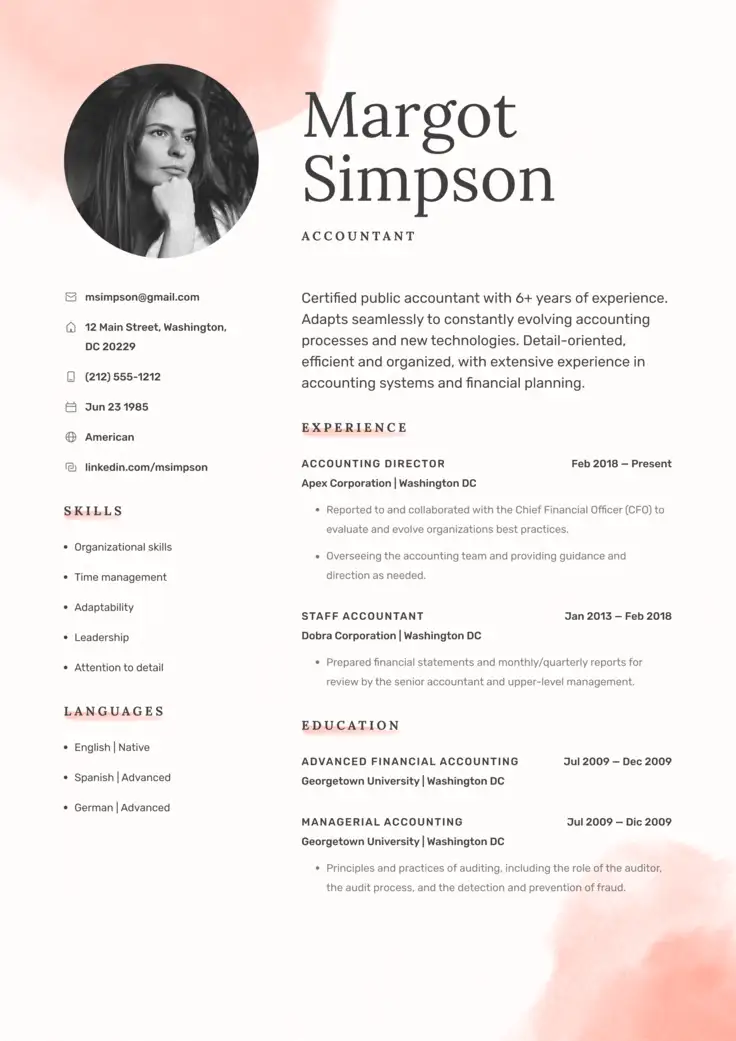
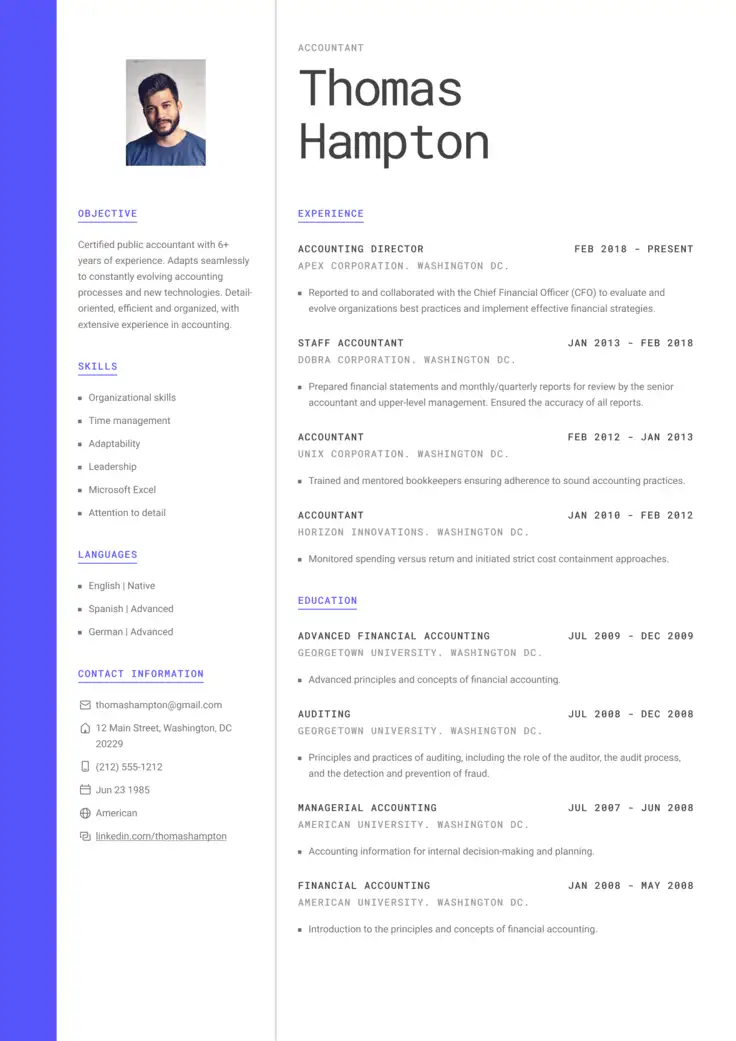
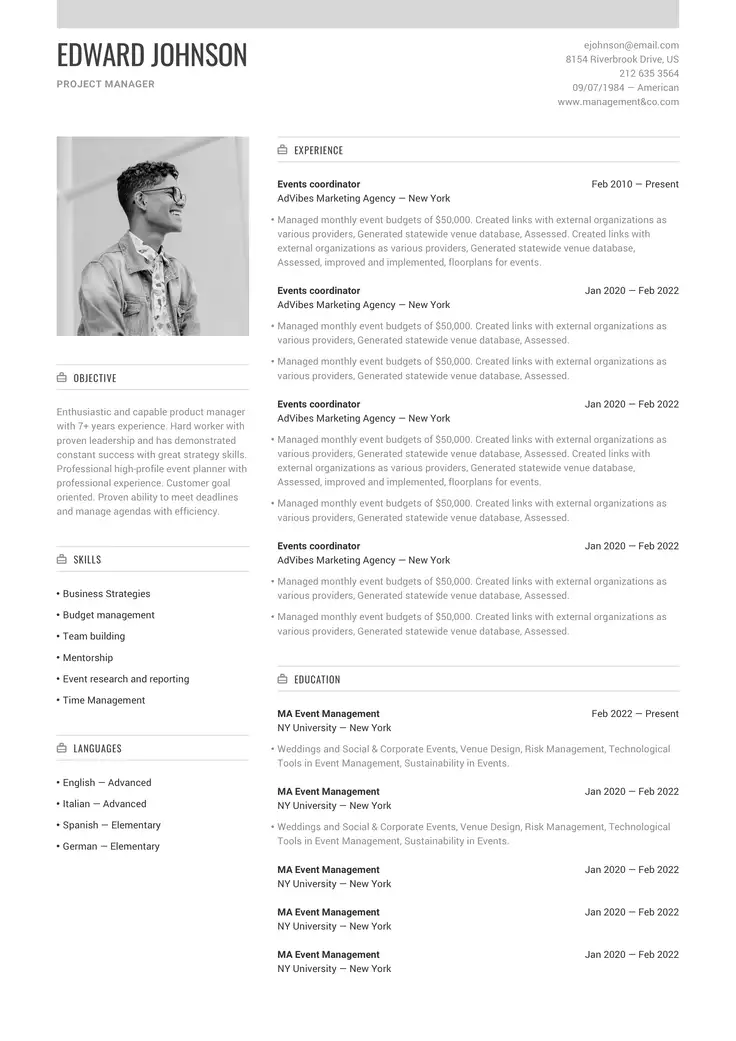
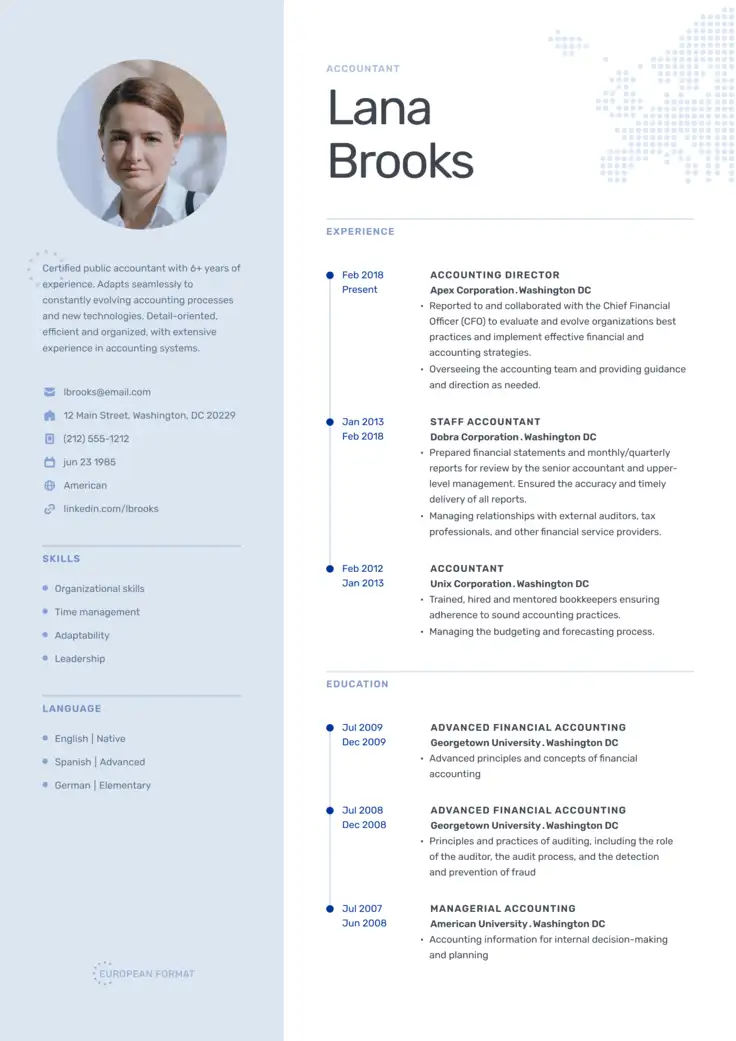
Entry-level software engineer resume sample
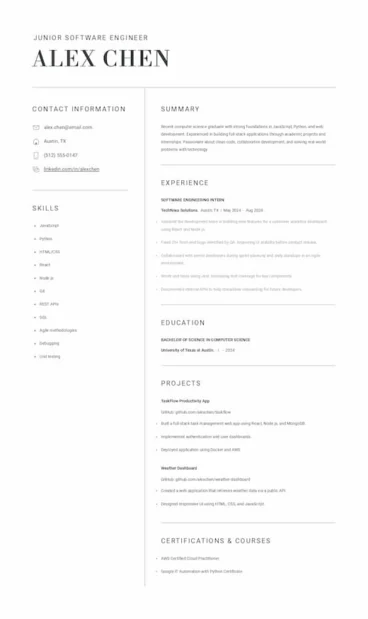
Alex Chen
Junior Software Engineer
📍 Austin, TX | 📞 (512) 555-0147 | 📧 alex.chen@email.com
🔗 linkedin.com/in/alexchen | github.com/alexchen
Summary
Recent computer science graduate with strong foundations in JavaScript, Python, and web development. Experienced in building full-stack applications through academic projects and internships. Passionate about clean code, collaborative development, and solving real-world problems with technology.
Skills
JavaScript | Python | HTML/CSS | React | Node.js | Git | REST APIs | SQL | Agile methodologies | Debugging | Unit testing
Work Experience
Software Engineering Intern
TechNova Solutions, Austin, TX | May 2024 to August 2024
- Assisted the development team in building new features for a customer analytics dashboard using React and Node.js.
- Fixed 20+ front-end bugs identified by QA, improving UI stability before product release.
- Collaborated with senior developers during sprint planning and daily standups in an Agile environment.
- Wrote unit tests using Jest, increasing test coverage for key components.
- Documented internal APIs to help streamline onboarding for future developers.
IT Support Assistant
University of Texas IT Services, Austin, TX | September 2023 to May 2024
- Provided technical support to 200+ students and faculty, resolving software and hardware issues.
- Assisted with the installation and configuration of campus software tools.
- Helped troubleshoot network connectivity and system login issues.
- Created simple automation scripts in Python to speed up routine system checks.
- Documented troubleshooting procedures to improve support efficiency.
Education
Bachelor of Science in Computer Science
University of Texas at Austin, 2024
Certifications
- AWS Certified Cloud Practitioner
- Google IT Automation with Python Certificate
Projects
TaskFlow Productivity App
GitHub: github.com/alexchen/taskflow
- Built a full-stack task management web app using React, Node.js, and MongoDB.
- Implemented authentication and user dashboards.
- Deployed application using Docker and AWS.
Weather Dashboard
GitHub: github.com/alexchen/weather-dashboard
- Created a web application that retrieves weather data via a public API.
- Designed responsive UI using HTML, CSS, and JavaScript.
Example of a mid-level software engineer resume
Madison Brooks
Software Engineer
🏠 Chicago, IL | 📞 (512) 555-0147 | 📧 madison.brooks@email.com
🔗 linkedin.com/in/mbrooks | github.com/madisonbrooks | m.brooks.dev
Personal Statement
Software engineer with 5+ years of experience developing scalable web applications and backend services. Skilled in JavaScript, Python, and cloud infrastructure. Proven track record of improving application performance, delivering high-quality code, and collaborating across engineering teams.
Skills
JavaScript | TypeScript | React | Node.js | Python | AWS | Docker | Kubernetes | PostgreSQL | REST APIs | CI/CD | Agile
Work Experience
Software Engineer
Nexora Systems, Chicago, IL | September 2024 to Present
- Developed microservices for a SaaS analytics platform used by 30,000+ customers.
- Reduced API response times by 40% by optimizing database queries and caching.
- Implemented CI/CD pipelines that shortened deployment time by 50%.
- Led development of new dashboard features, increasing user engagement by 25%.
- Collaborated with product managers and designers to deliver features across bi-weekly Agile sprints.
Junior Software Engineer
BlueCircuit Software, Chicago, IL | August 2022 to August 2024
- Built front-end components using React and TypeScript for enterprise dashboards.
- Contributed to backend services supporting high-volume data processing systems.
- Fixed 100+ software issues reported by QA and customers.
- Improved database indexing strategies, boosting data retrieval speeds by 30%.
- Participated in peer code reviews to maintain code quality standards.
Projects
OpenBudget Personal Finance App
GitHub: github.com/madisonbrooks/openbudget
- Developed a budgeting platform with React, Node.js, and PostgreSQL.
- Implemented secure authentication and real-time expense tracking.
Developer Portfolio Website
m.brooks.dev
- Designed and built a responsive portfolio website showcasing technical projects.
- Integrated GitHub APIs to display real-time repository activity.
Education
Bachelor of Science in Computer Science
University of Colorado Denver, 2022
Certifications
- AWS Certified Developer – Associate
- Certified Kubernetes Application Developer (CKAD)
Senior software engineer resume example
Tyler Bennett
Senior Software Engineer
📍 San Diego, CA
📞 (512) 555-0147
📧 tyler.bennett@email.com
🔗 linkedin.com/in/tylerbennett | github.com/tylerbennett | tylerbenett.dev
Summary
Senior software engineer with 10+ years of experience designing scalable distributed systems and leading engineering teams. Expert in cloud architecture, microservices, and performance optimization. Proven ability to deliver enterprise platforms serving millions of users while mentoring engineers and driving technical strategy.
Skills
System architecture | Distributed systems | Microservices | AWS | Kubernetes | Node.js | Python | Go | PostgreSQL | CI/CD | DevOps | Leadership
Work Experience
Senior Software Engineer
CloudPeak Solutions, San Diego, CA | January 2023 to Present
- Built a cloud-native platform handling 5M+ monthly users.
- Lead a team of 8 engineers developing scalable microservices.
- Reduced infrastructure costs by 35% through optimized cloud resource allocation.
- Implemented event-driven architecture, improving system reliability and scalability.
- Mentored junior engineers and conducted technical interviews for new hires.
Software Engineer
Ironwood Digital, San Diego, CA | September 2018 to December 2022
- Developed backend services powering analytics dashboards for enterprise clients.
- Improved application performance by 40% through optimized caching strategies.
- Built automated deployment pipelines, reducing release cycles from 2 weeks to 2 days.
- Collaborated with cross-functional teams to design new platform features.
- Contributed to system architecture planning for next-generation SaaS platforms.
Junior Software Engineer
BrightForge Technologies, San Francisco, CA | August 2015 to August 2018
- Implemented front-end components using React and TypeScript.
- Supported backend services handling real-time data processing.
- Resolved 100+ software issues reported by QA and customers.
- Improved database performance through query optimization.
- Participated in Agile development cycles and peer code reviews.
Projects
RealTime Analytics Engine
GitHub: github.com/tylerbennett/realtime-analytics
- Built a distributed data processing system using Kafka and Kubernetes.
- Designed architecture capable of handling millions of daily events.
Open Source DevOps Toolkit
GitHub: github.com/tylerbennett/devops-toolkit
- Created open-source automation tools used by 1,000+ developers.
Education
Bachelor of Science in Computer Science
California State University, 2015
Certifications
- AWS Certified Solutions Architect – Professional
- Certified Kubernetes Administrator (CKA)
Languages
- English (Native)
- Spanish (Professional)
How To Format a Software Engineer Resume
When writing your resume, keep in mind the following tips to structure your technical skills and experience clearly:
- Use a reverse-chronological format
- Stick to one page in length (two pages if you’re a highly experienced)
- Use consistent fonts, headings, and spacing to keep things well organized
- Include links to portfolios, GitHub, and/or LinkedIn to highlight your projects
- Use bullet points, not long paragraphs, to describe your experiences
- Quantify your results whenever possible
Make sure your resume is easy to scan at a glance by leaving enough white space between sections. Avoid overly decorative designs, since a simple structure makes the document more readable for both recruiters and applicant tracking systems (ATS).
How To Write a Resume for a Software Engineer Step-By-Step
Writing a software engineer resume is easier when you break the process into clear steps.
The guide below will help you structure your resume, present your experience effectively, and create a document that is clear and professional.
- Define your target role to tailor your resume to the job you want.
- Write a clear resume summary highlighting your strengths.
- Detail your work experience and quantify achievements.
- Showcase relevant software engineering projects.
- Include your educational background (computer science or related fields).
- Add professional certifications that validate your technical expertise.
- List key technical and transferable skills.
- Highlight AI knowledge or tools relevant to modern software engineering roles.
- Include useful links such as GitHub, portfolio sites, or live demos.
1. Define the target role
There are many different types of software engineers: front-end, backend, full-stack, and mobile, to name just a few. So, before writing your resume, you should decide what role you want to pursue.
Once you’ve located a job opening, analyze the job description. Determine which programming languages, frameworks, and projects to emphasize, keeping in mind that these keywords are needed to get past the ATS.
2. Write a clear summary statement
Your summary statement should include key facts that make you stand out. Mention your years of experience, most important skills, core technologies you can use, and other qualifications.
Decide on a specialty and pair it with a proof point, such as a notable project, domain, or impact metric.
Example
Software engineer with 6+ years of experience building scalable web applications and backend services. Proficient in JavaScript, Python, and cloud platforms such as AWS, with expertise in developing microservices and performance optimization. Specialized in data-driven SaaS platforms, including leading development of an analytics feature that improved application response time by 40% and supported tens of thousands of users.
You can use our AI resume summary generator for instant suggestions on what to include in your personalized summary statement.
3. Detail your experience and quantify your achievements
In your work experience section, list your recent and relevant roles in reverse-chronological order, starting with the most recent and working your way back.
Each entry should include bullet points describing your achievements, key responsibilities, and measurable results.
If you lack professional experience in your field, look for ways to highlight transferable skills from other jobs in your entry-level resume. You can also include non-work relevant experiences, such as personal projects, academic projects, or pro bono work.
Example
Backend Software Engineer
BlueWave Technologies, Denver, CO | June 2021 to Present
- Improved system monitoring with logging and alert tools, helping reduce service downtime by 25%.
- Designed and maintained backend services for a logistics platform supporting 120,000+ monthly users.
- Reduced average API response time by 32% by optimizing database queries and implementing Redis caching.
- Built new REST API endpoints in Python and FastAPI, enabling faster integration with partner applications.
- Collaborated with product managers and front-end developers to deliver 15+ new features across multiple releases.
- Automated deployment pipelines using GitHub Actions and Docker, reducing release preparation time by 40%.
4. Share relevant software engineering projects
This section highlights practical skills, especially if you’re a junior engineer with less experience or changing from a different career field. Your Projects section proves that you can use tools, solve problems, and build real products.
Each project should include a short, bullet-point description including the technologies used and project outcomes.
Example
FleetTrack Logistics Platform
GitHub: github.com/jordan-dev/fleettrack
- Developed a full-stack logistics tracking application using React, Node.js, and PostgreSQL.
- Implemented real-time shipment tracking with WebSockets, supporting 10,000+ daily status updates.
- Designed REST APIs for route management and delivery scheduling.
- Deployed the platform using Docker and AWS, improving scalability and system reliability.
5. Include your educational background
Software engineering is a fast-moving industry, especially if you specialize in AI, cloud computing, or security.
Including relevant degrees, online courses, and bootcamps in your Education section shows that you are keeping up. If you’re early in your career, you can also highlight honors you’ve received or specific coursework.
Example
Bachelor of Science in Computer Science
University of Colorado Boulder, Boulder, CO | 2018
- Relevant Coursework: Data Structures, Algorithms, Software Engineering, Database Systems, Artificial Intelligence
- Senior Capstone Project: Developed a cloud-based event scheduling platform used by 500+ university users
- Dean’s List: Fall 2016, Spring 2017
6. Add your professional certifications
A dedicated certifications section is especially useful because tools and platforms evolve so quickly. Recent certifications provide proof that you can hit the ground running. Avoid including outdated or low-value certifications on your resume.
Example
- AWS Certified Solutions Architect – Associate
- Certified Kubernetes Application Developer (CKAD)
- Google Professional Cloud Developer
- Scrum Master Certified (SMC)
- Python for Data Science and AI (IBM)
7. List technical and transferable skills
Your main focus should be on technical skills. However, you might consider including some soft and transferable skills to demonstrate balance. Don’t forget to review the job description to determine what skills are required.
Below, we’ve collected the top skills needed for different aspects of software engineering.
Programming
- Data structures and algorithms
- Problem-solving
- Version control (Git)
- Functional programming
- Testing and debugging
Backend
- Server-side languages
- Database management
- API design and RESTful services
- Authentication and security
- Cloud services
Frontend
- Core UI technologies
- Frontend frameworks
- Responsive design
- State management
- UX understanding
Modern engineering
- Cloud and container orchestration
- CI/CD pipelines
- Microservices architecture
- Monitoring and logging
- Automation and scripting
You can get a custom list of skills to add to your resume by plugging your desired job title and industry into our AI skills generator.
8. Highlight AI knowledge
A keen understanding of AI is increasingly expected. Many teams now use AI to speed up software development, automate workflows, and build smarter products.
When you demonstrate practical use of AI, it signals traits like adaptability, efficiency, and awareness of current engineering practices. You can do this by including the following on your resume:
- AI-assisted coding tools
- Integrating LLM APIs
- Automation scripts
- Data processing
- Machine learn (ML) concepts
9. Include useful links (GitHub, portfolio, demos)
You can include useful links along with your contact information. This allows the hiring manager to see what you’ve already accomplished with a single click.
The best links are professional-only, not personal social media accounts. If you have a portfolio, LinkedIn profile, GitHub, or videos of live demonstrations, include them. This is especially valuable for technical or product-focused roles.
Best Practices To Write a Software Engineer Resume in 2026
As with programming, there are certain things you always do and others you avoid. Use these do’s and don’ts as a checklist to highlight your strengths while avoiding common pitfalls.
Do’s ✅
- Tailor your resume to each job
- Use measurable achievements
- Keep your layout clean
- Focus on your impact
- Highlight modern tools
- Include relevant links
- Use concise bullet points
- Prioritize technical skills
Don’ts ❌
- Use a generic resume
- List irrelevant technology
- Write long paragraphs
- Misrepresent your skills
- Forget to proofread for errors
- Overload with buzzwords
- Use overly complex designs
- Ignore soft skills completely
Struggling with Resume Writing?
Ease the process with our templates
FAQs About Software Engineer Resumes
Most should limit their resumes to one page. If you are a senior engineer with a lot of experience and qualifications, you can extend your resume to two pages.
Yes, you can include coding assistants like GitHub Copilot and Tabnine, but you should give careful thought to how you present them. List them under technical skills alongside other tools, or describe the results (such as reducing coding time) when using them in past projects.
Don’t overemphasize them, as employers will value your coding ability and problem-solving skills over the use of these tools.
Focus on what you built or improved, the technologies you used, and the impact of your work. You might write, “Contributed [x] features using [x tools].” Or you could say, “Collaborated with maintainers and community through pull requests and code reviews.”
Don’t forget to include a link so recruiters can view your code.
Yes, even if it’s not required, writing a cover letter can make your application more memorable. It provides more room for including job description keywords and highlighting why you’re the ideal candidate for the job.
Related Professions